
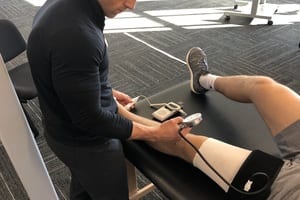
What if you could build strength and muscle — without putting stress on a healing joint or tissue? That’s the science behind Blood Flow Restriction (BFR) therapy, an exciting and researched advancement in modern rehabilitation.
At Makovicka Physical Therapy, our trained clinicians use BFR to help patients recover faster, get stronger sooner, and return to the activities they love — with less pain along the way.
How Does BFR Work?
BFR uses a specialized cuff — similar to a blood pressure cuff — applied to the upper arm or upper thigh. Using Doppler ultrasound to precisely monitor pressure, your therapist carefully restricts venous blood flow (blood leaving the muscle) while maintaining arterial flow (blood entering the muscle).
This controlled environment tricks the body into responding as if it’s working much harder than it actually is. The result? Your muscles experience the same strength and size adaptations that normally only come from heavy, high-load resistance training — but at a fraction of the weight.
For patients in recovery, that distinction is everything.
The Science Behind the Results
When muscles work under low oxygen conditions — even briefly — the body responds with a powerful adaptive response. This includes increased muscle protein synthesis, elevated growth hormone release, and enhanced motor unit recruitment. These are the same physiological mechanisms triggered by heavy lifting, now accessible to patients who can’t yet tolerate that kind of load.
BFR doesn’t just work around your injury. It actively promotes recovery. Train smarter. Recover faster. Protect what matters.
BFR is a versatile tool with applications across a wide range of patients and conditions:
Post-Surgical Recovery: After surgery, muscle loss and weakness set in quickly — sometimes within days. BFR allows patients to begin meaningful strength training earlier in recovery, when heavy loading isn’t safe or possible. It’s particularly effective following orthopedic procedures such as ACL reconstruction, rotator cuff repair, and total joint replacements.
Pre-Surgical Preparation (Prehab): Stronger patients going into surgery tend to recover better. BFR can be incorporated into a pre-operative rehabilitation program to build a stronger foundation before your procedure, leading to quicker improvements in strength and function post-surgery.
Injury Rehabilitation: From weekend warriors to competitive athletes, BFR accelerates the return to sport and activity by maintaining and rebuilding muscle mass during the phases of recovery when traditional loading isn’t appropriate.
General Strength & Conditioning: BFR isn’t limited to injured or post-surgical patients. Older adults, individuals managing chronic joint pain, and those with load-sensitive conditions can all use BFR to safely build strength and preserve muscle mass over time.
Conditions Commonly Treated with BFR
- ACL tears and reconstruction recovery
- Rotator cuff injuries and repairs
- Total knee and hip replacement recovery
- Muscle atrophy from immobilization or illness
- Tendinopathies and overuse injuries
- Chronic joint pain that limits traditional exercise
- Pre-surgical weakness or deconditioning
Safe, Monitored, and Proven
Safety is central to how BFR is practiced at Makovicka Physical Therapy. Cuff pressure is never applied arbitrarily — it is individually calibrated using Doppler ultrasound to achieve the precise level of restriction needed for your body and your goals. Your therapist monitors you throughout each session to ensure the approach is both effective and appropriate for where you are in your recovery.
BFR is backed by a growing body of clinical research and is increasingly adopted by rehabilitation professionals, military medical teams, and sports medicine programs around the world. Its efficacy in improving muscular strength and size with low-load exercise has been demonstrated across both healthy populations and clinical rehabilitation settings.
Every Makovicka Physical Therapy clinic has staff trained in Blood Flow Restriction therapy. Our clinicians don’t apply BFR as a one-size-fits-all solution — they integrate it into a comprehensive, individualized treatment plan tailored to your diagnosis, your surgery, or your recovery goals.
Whether you’re preparing for a procedure, rebuilding after one, or simply trying to get stronger without aggravating a painful joint, BFR may be exactly the tool your recovery needs.